one dimensional billiards
Consider the case of three identical balls moving in one dimension.
The problem is to understand how many collisions between the balls are possible given any initial conditions.
Define α as a dimensionless measurement of the elasticity of each collision, with 0 < α < 1 , where α is the fraction of total momentum
remaining after the collision. For perfectly elastic balls, α = 1.
before:
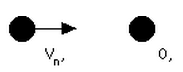
after:
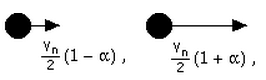
Put a 3rd ball into the picture, and try to imagine how the above situation could repeat itself.
It turns out that there's a particular value of α which acts like a sharp "phase transition", with one answer for the number of possible collisions for large α , and a different answer for small α .
What is that α, and what are the number of possible collisions in the two cases?

![[paper clip]](/courses/source/wiki_images/paper_clip_tilt.png)
 name last modified size
