Nov 17
physics and group theory
At the size scale where we live, "classical" physics (Newtonian mechanics, electromagnism, thermodynamics, ...) are what governs most of what we see.
But behind most of that is quantum physics. And the math behind quantum physics is mostly group theory, because it's all about symmetries of things, and particularly what various transformations (rotate, boost, slide, ...) can conceivably do.
I'm going to give several specific examples, but first the "big picture".
(Explain the gist of that.)
Big idea 1: the symmetries of space-time constrain what sorts of "things" can conceivably exist.
Step by step:
- discuss the idea of a "representations" of a group.
- ... and that the "thing" it transforms must behave consistently.
- ... and that therefore given physical symmetry (like rotations), the things that can be rotated (like electrons) can only have certain possible properties.
Quanutm physics:
- The theory is made up of "operators" (rotate 120 deg) and "observables" (where is it).
- Any measurement changes the world ... so it turns out these operators and observables are interconnected.
- ... and in fact are the same thing: for each thing you want to observer, there is a corresponding operator that "makes" that measurement.
Example 1:
 Position and momentum are "operators",
 not just properties of a particle.
 Moreover, they don't commute.
 You get different answers for X P than P X.
 (How weird is that?)
 In fact, the difference between the two
 is the quantum uncertainty :
 X P - P X = Plank's constant = h = 6e-34 Joule sec
 where X=position and P=momentum
Example 2:
 "Spin" of a particle is actually its symmetry under rotations ...
 as well as its "intrinsic" angular momentum.
 (explain magnets and particle beams)
  Spin 0   : no spin at all
  Spin 1   : 3 spots ; rotations are 3x3 matrices
  Spin 1/2 : 2 spots ; rotations are 2x2 complex matrices
             ... where 360 rotation = multiply by (-1)
 (explain trying to turn coffee cup without letting go)
Example 3:
 Wavefunctions for 2 particles
 and symmetry under exchange.
  a) "even" parity (+1)
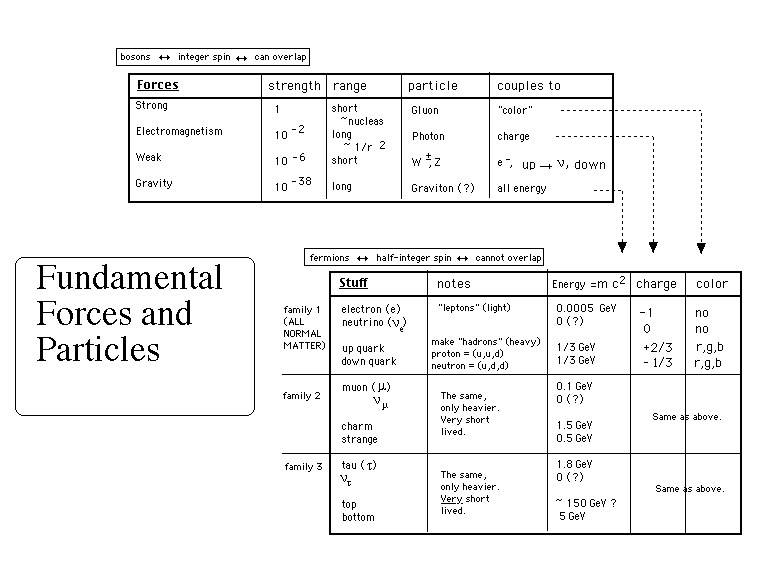
     ... which turn out to be "bosons"
     ... which are the forces (i.e. light, gravity)
  b) "odd" parity (-1)
     ... which turn out to be "fermions"
     ... which is the "stuff" (i.e. quarks, electrons)
Example 4:
 The "group" for space-time is the "Poincare group"
 (wikipedia:poincare_group) which has 10 "directions".
 The consistent ways to have "things" which can be
 shifted in these ways gives
  a) spin, and
  b) particle / antiparticle pairs
 In particular, the boosts don't commute:
   Vx Vy - Vy Vx = Rotate_z
   ... but the math is consistent with + or - rotation.
   So ... particles do one thing, antiparticles the other.
There are lots of other examples; QM is full of this stuff.
- quarks
- CPT symmetry
- conjugate pairs:
- position / momentum
- time / energy
- angle / angular momentum
Very cool stuff.

![[paper clip]](/courses/source/wiki_images/paper_clip_tilt.png)
 name last modified size
