feb 1
- go over homework; see homework
- sample C code for a tree
- sample C code for decimal to binary conversion
- dicussion of others
- start next chapter
- don't let the math freak you out; we'll do some of that but not all
- essential question: how do we measure what a good algorithm is?
 size of input :
   - for numbers, number of bits it takes to write it down
   - but usually just the number of "things" we're given
 time :
   - typically number of "basic operations"
   - usually what people focus on
 space :
   - bit harder to quantify exactly
   - ... and usually there's a time/space trade-off
 asymptotic behavior is what we usually cae about
   1   n   log(n)    n*log(n)   n**2    n**3  2**n   n!
and in particular: EXPONENTIAL IS BAD.
worst-case vs best-case vs average-case
 O(f(n)) notation :
 any function that doesn't grow faster
 than a multiple of f(n) as n gets big
How to do all this for specific cases?
There are two general approaches: theory (do the math and prove a result)
vs experiment (run your algorithm and see what happens)
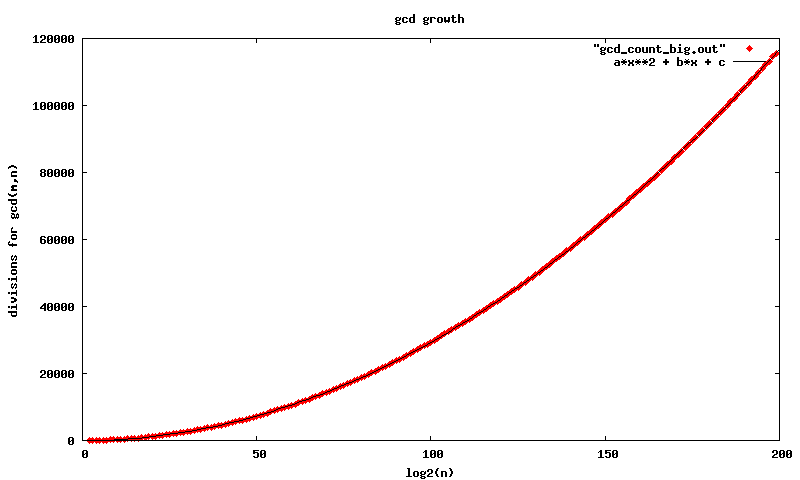
One easy way to draw the graphs for the "run it and see"
is with gnuplot.
Example